


The Dangerous Chemicals Found in Fast Food and Restaurants
Two years ago, Ami Zota studied fast food consumption in the United States and found that as millions of people are eating fast food outside their homes, they’re also ingesting harmful chemicals.
Called phthalates, this class of chemicals is linked to infertility, pregnancy complications, diabetes, obesity and cancer. They’re found in plastics, lotions, cosmetics, personal care products, vinyl flooring, and other common household items. But they’re also found in the gloves, boxes and plastic wrap used to prepare food.
The 2016 study revealed that those who reported eating more fast food were exposed to as much as 40 percent more phthalates than those who ate at home in the span of 24 hours. Grain-based foods, including bread, cake, pizza, burritos, rice, and noodles, and burgers and other meat were the most significant contributors to phthalate exposure.
According to Zota, ScD, MS, an assistant professor of environmental and occupational health at the Milken Institute School of Public Health, these findings were especially worrisome because of the number of serious health concerns associated with exposure to phthalates.
In March 2018, Zota and other researchers published the findings of a broader study that examined the phthalate levels of those who ate different types of food away from home. This included restaurant food, cafeteria food and fast food.
-
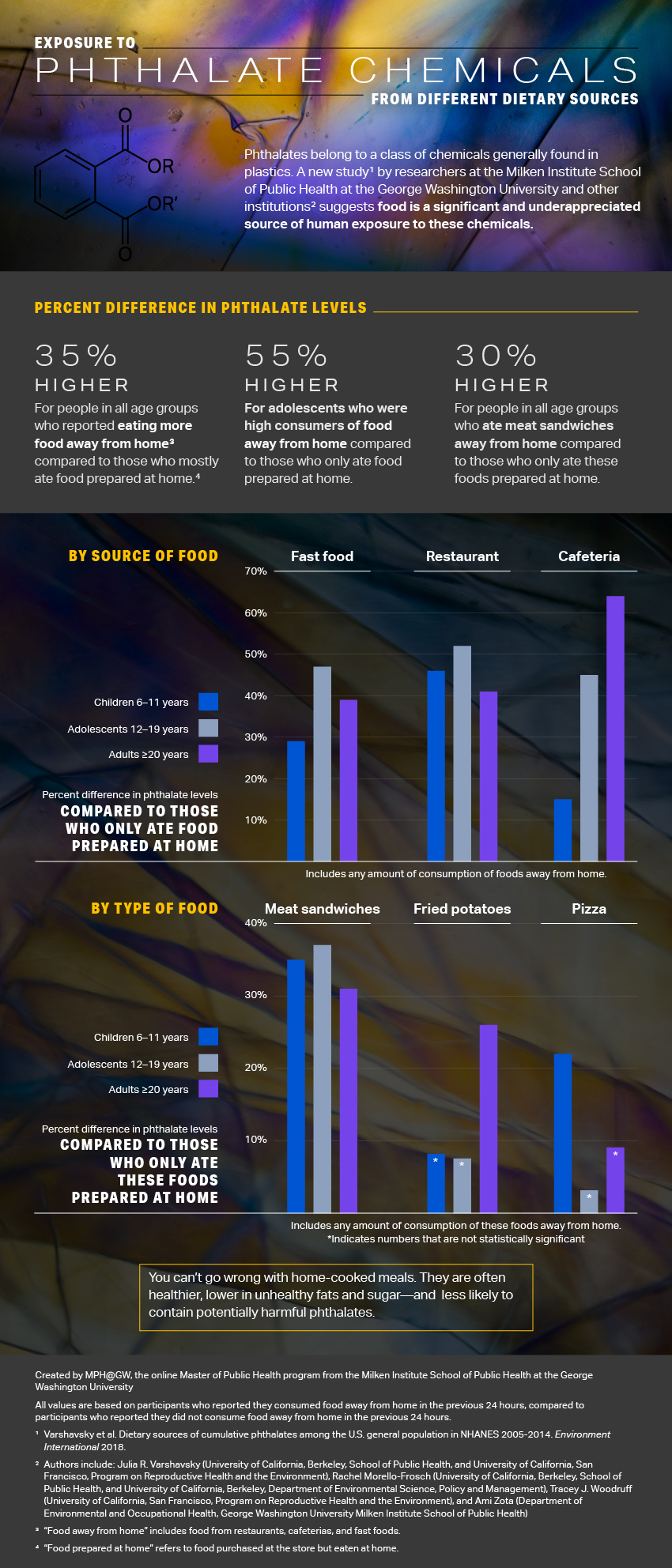
Phthalates belong to a class of chemicals generally found in plastics. A new study1 by researchers at Milken Institute School of Public Health at the George Washington University and other institutions2 suggests food is a significant and underappreciated source of human exposure to these chemicals.
Percent difference in phthalate levels:
- 35% higher for people in all age groups who reported eating more food away from home3 compared to those who mostly ate food prepared at home.4
- 55% higher for adolescents who were high consumers of food away from home compared to those who only ate food prepared at home.
- 30% higher for people in all age groups who ate meat sandwiches away from home compared to those who only ate them prepared at home.
Percent difference in phthalate levels for people who dined out compared to those who only ate food prepared at home:
By age group and source of food:
Dining Out Source Children (6-11) Adolescents (12-19) Adults (20 or Older) Fast food restaurant29%47%39%Full-service restaurant46%52%41%Cafeteria15%45%64%By age group and type of food:
Type of Food Children (6-11) Adolescents (12-19) Adults (20 or Older) Meat sandwiches35%37%31%Fried potatoes8.2%57.6%526%Pizza22%3.2%59.1%5Includes any amount of consumption of foods away from home.
Conclusion
You can’t go wrong with home-cooked meals. They are often healthier, lower in unhealthy fats and sugar — and this study suggests they’re less likely to contain potentially harmful phthalates.
Created by MPH@GW, the online Master of Public Health program from the Milken Institute School of Public Health at the George Washington University
1 Varshavsky et al. Dietary sources of cumulative phthalates among the U.S. general population in NHANES 2005-2014. Environment International 2018.
2 Authors include: Julia R. Varshavsky (University of California, Berkeley, School of Public Health, and University of California, San Francisco, Program on Reproductive Health and the Environment), Rachel Morello-Frosch (University of California, Berkeley, School of Public Health, and University of California, Berkeley, Department of Environmental Science, Policy and Management), Tracey J. Woodruff (University of California, San Francisco, Program on Reproductive Health and the Environment), and Ami Zota (Department of Environmental and Occupational Health, George Washington University Milken Institute School of Public Health)
3 “Food away from home” includes food from restaurants, cafeterias, and fast foods
4 “Food prepared at home” refers to food that was purchased at the store but eaten at home
5 Indicates numbers that are not statistically significant
Citation for this content: MPH@GW, the online MPH program from the Milken Institute School of Public Health at the George Washington University