


Water Use in the U.S. vs. Cape Town
If you take a five-minute shower and flush your toilet once, you’ve already used more than the daily allotment of water for Cape Town, South Africa, residents. As the city approaches “Day Zero,” the day that Cape Town is expected to run out of water, strict regulations have been implemented to extend the life of the available water supply. At first, residents were limited to 23 gallons per person per day, but now they are restricted to 13 gallons, pushing “Day Zero” back from June 4 to July 9.
In recent days, even though its dams are still only at 23.6 percent of capacity, the government of Cape Town claims that “Day Zero” has been pushed back even further to 2019, thanks to the water restrictions.
As Cape Town faces this water shortage, other cities around the globe should take note. In order to put the current crisis in perspective for Americans, we created the following graphic to compare the average amounts of household water use in the U.S. to the current daily restrictions for Capetonians.
-
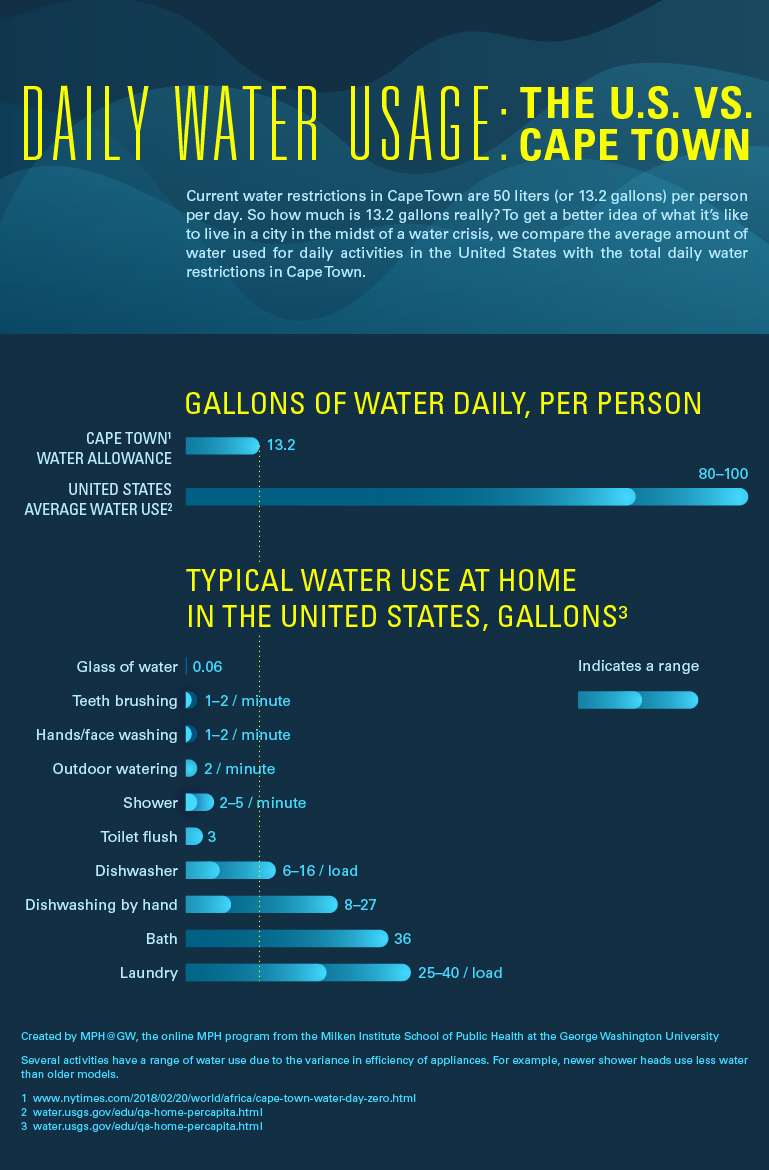
Water restrictions in Cape Town are 50 liters (or 13.2 gallons) per person per day. How much is 13.2 gallons? To get a better idea of what it’s like to live in a city in the midst of a water crisis, we compare the average amount of water used for daily activities in the United States with the total daily water restrictions in Cape Town.
Daily water allowance in Cape Town per person = 13.2 gallons1
Average daily water use for the average person in the United States = 80 – 100 gallons2
Typical Water Use at Home in the United States3
Activity Average Amount of Water Used* Bath36 gallonsShower2 – 5 gallons per minuteToothbrushing1 – 2 gallons per minuteWashing hands and face1 -2 gallons per minuteDishwasher6 – 16 gallons per minuteDish-washing by hand8 – 27 gallonsClothes washer25 – 40 gallons per loadToilet flush3 gallonsGlass of drinking water.0625 gallonsOutdoor watering2 gallons per minute*Note: Several activities have a range of water use due to the variance in efficiency of appliances. For example, newer shower heads use less water than older models.
Resources
1https://www.nytimes.com/2018/02/20/world/africa/cape-town-water-day-zero.html Return to footnote reference
2https://water.usgs.gov/edu/qa-home-percapita.html Return to footnote reference
3https://water.usgs.gov/edu/qa-home-percapita.html Return to footnote reference
Citation for this content: MPH@GW, the online MPH program from the Milken Institute School of Public Health at the George Washington University